Journey
Your first project: ten steps, about four weeks
Not a course, not a certificate. Ten tasks in the real world. Every step has a task, a guide and a proof. You submit what you did, and the next step opens.
- 10 steps
- about four weeks
- about 9 h 45 min in total
- no experience needed
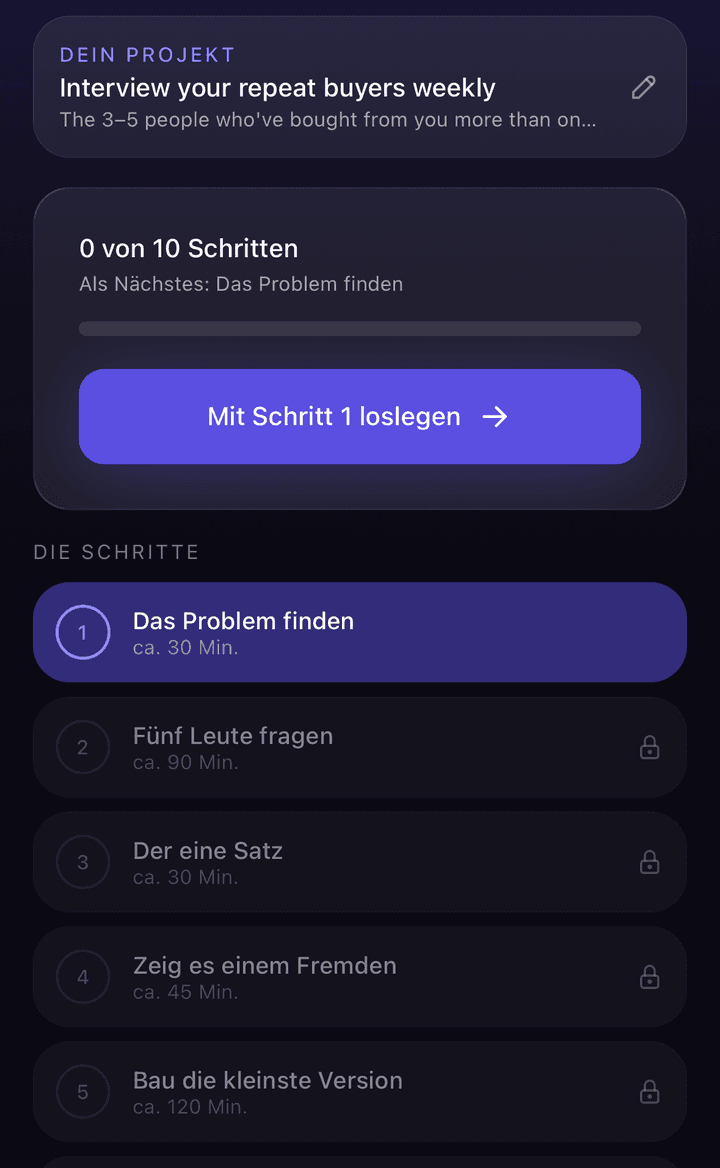
Ten steps, about four weeks. No money, no experience. Just you and something that annoys you. At the end, something exists that did not before.
Before you start
First the project, then the first step
Three questions at the start, that is all the app needs. From then on every guide is about your project and not about an invented one.
What are you working on?
One sentence is enough. It does not have to be finished, a plan will do.
Who is it for?
A group of people, not a market study. Who actually has the problem?
What annoys those people?
This is where your project starts. The more concrete you name it, the more useful every guide afterwards gets.
Almost every company that exists started because something annoyed someone. You do not need a brilliant idea. You need a problem that is real.
Anatomy
How a step is built
Each of the ten steps has the same four parts. From the start you know why you are doing something, what exactly to do, and how you can tell you are done.
Why it matters
Two or three sentences on the reason. Not a motivational line, but why almost everyone skips this step and what it costs them.
Your task
An assignment, not a topic. Clear enough that you know right away whether you have done it. With a time estimate, so you know what you are getting into.
How to do it
The guide. It is written for your project, not in general, out of what you entered at setup.
What counts as proof
Named up front, so you are not guessing: what you have to submit for the step to count as done.
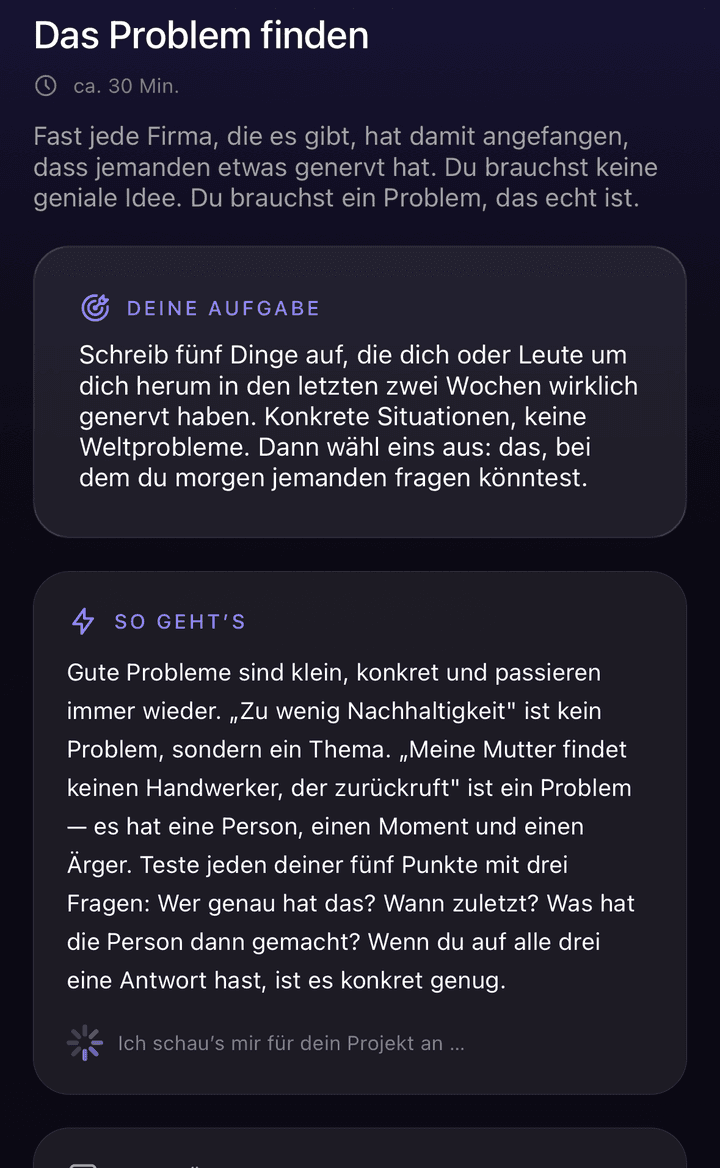
Example · Step 2
Ask five people
about 90 minutes
The difference between an idea and a business is five conversations. Almost everyone skips them and spends months building something nobody wanted.
- Why it matters
- Almost everyone skips this step. They build for weeks and find out at the end that nobody wanted it. Five conversations cost you about an hour and a half.
- Your task
- Talk to five people who actually have the problem, not five people who like you. Do not pitch, ask.
- How to do it
- The guide names who to approach, how to start and what to ask. The core is the same in every project: you do not present a solution, you ask about the last time the problem came up. Then you listen.
- What counts as proof
- Five conversations, five notes: who you talked to and what stuck with you, in your own words. Text is enough. You can attach a photo, but you do not have to.
The journey
All ten steps
In order. A step opens once the one before it has been submitted and accepted. The times are estimates from the app. Not everyone takes the same amount of time.
Find the problem
Write down five things that genuinely annoyed you lately, then pick one.
ca. 30 minutes
Ask five people
Talk to five people who actually have the problem. Do not pitch, just ask.
ca. 90 minutes
The one sentence
"I help [who] to [what]." Write five versions, delete four.
ca. 30 minutes
Show it to a stranger
Explain it in under a minute to someone you do not know.
ca. 45 minutes
Build the smallest version
Build something people can look at. Done today, not pretty.
ca. 120 minutes
First reach
Go where it feels uncomfortable, not just to your own friends.
ca. 60 minutes
Ask for a yes
Ask for a real commitment and count: how many yes, how many no.
ca. 60 minutes
The first euro
Proof of real money: screenshot, photo, message, booking confirmation.
ca. 90 minutes
What did not work
Write down honestly what went wrong. At least one paragraph.
ca. 30 minutes
Your 30-day report
One image and three sentences: what exists, what you learned, what comes next.
ca. 30 minutes
The question is not "what can I build", it is "what is the least someone can look at".
The proof
Done means: submitted
No step can be ticked off by ticking it off. For every step you submit what came out of it. Only then does the next one open.
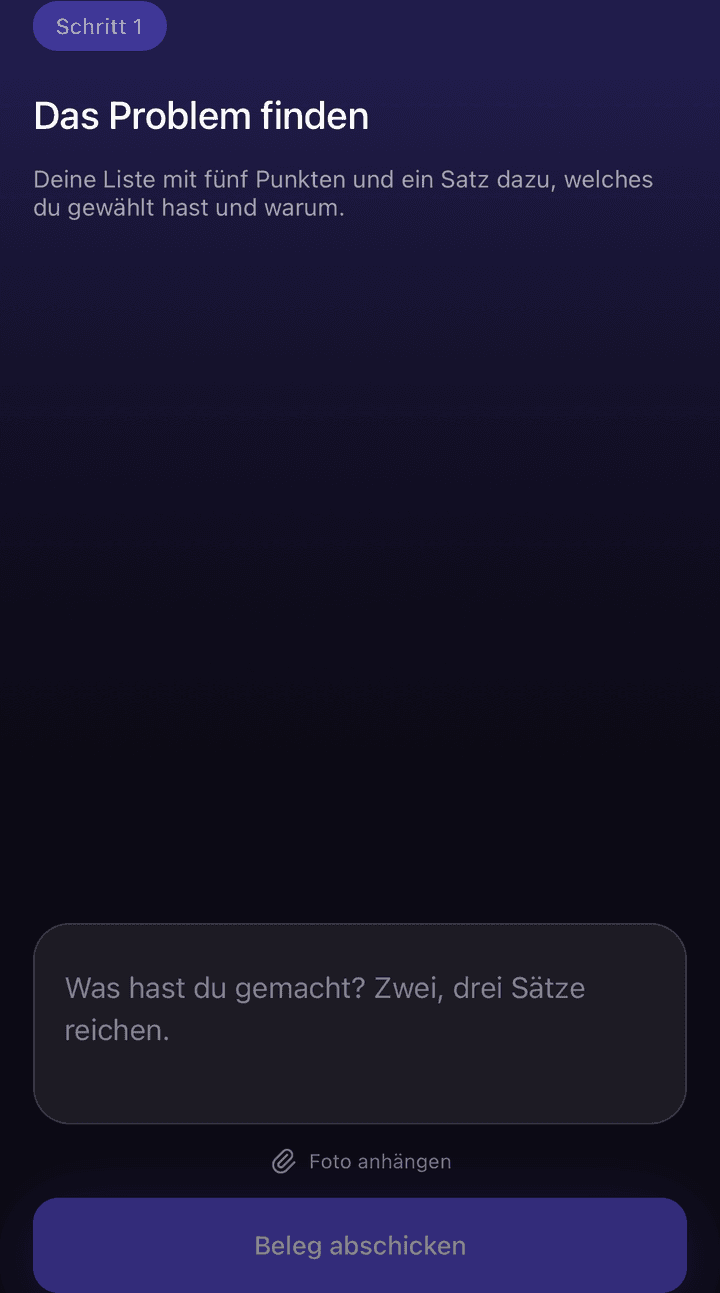
You submit
Text, in your own words. You can attach a photo, but you do not have to.
The AI coach reads it
It checks whether what you submitted matches the task you were given.
One follow-up at most
If something is missing, exactly one follow-up question comes back. One, not five. You answer, and on it goes.
The next step opens
You get XP and your rank moves. The step after it is unlocked.
XP and rank
Who reads your proof
The guides and the feedback on your proof are written by an AI model (Claude by Anthropic). What you submit is transmitted to Anthropic for that. Your account and profile data sit on servers in the EU. The AI decides nothing about you: it does not sort anyone out and it does not grade you.
Everything about safety and dataAfter four weeks
What is there at the end
The last step is a report on the thirty days before it: one image and three sentences. What exists, what you learned, what comes next.
Step 10
Your 30-day report
One image and three sentences: what exists, what you learned, what comes next.
about 30 minutes, the last of 10 steps.
There is no certificate at the end. There is a project that did not exist before, ten pieces of proof that you actually did it, and a report you can show. At the next application, at the next interview, the next time someone asks what you actually do.
Numbers beat adjectives: "7 people said yes, 1 paid" is stronger than "went pretty well".
Start with the thing that annoys you.
The ten steps are in the app. You do not need an idea and you do not need permission, just one thing that genuinely bothers you.