Founder DNA
How journex knows who you are
No test and no box. journex has a conversation with you, looks for patterns and turns them into a profile: your archetype, your strengths across twelve axes, your rank and your first step.
The conversation
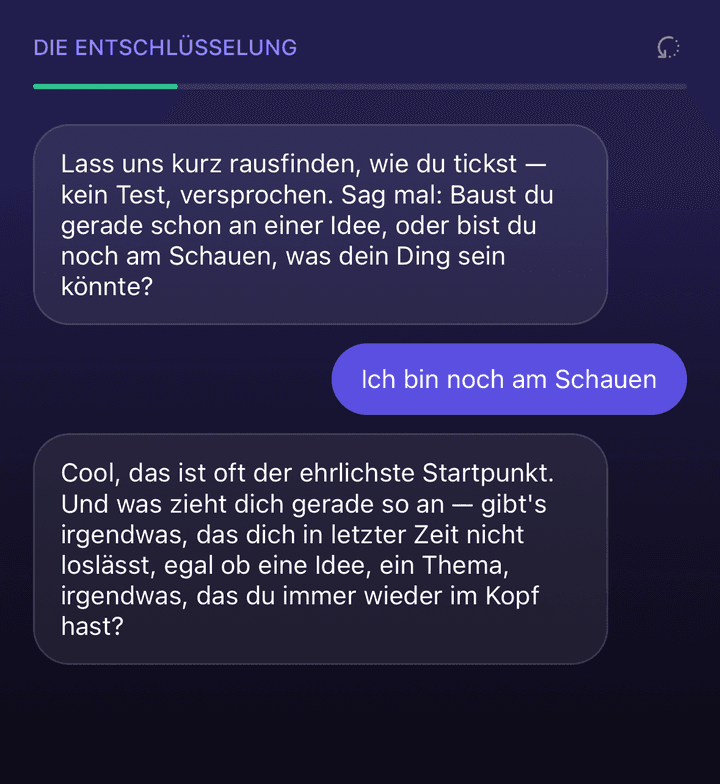
A conversation, not a questionnaire
The app starts without registration. You answer in full sentences, in your own words. The conversation is led by an AI model (Claude by Anthropic).
How it goes
- You start with the conversation itself. No account, no form up front.
- You write your answers yourself, in your own words.
- How much you write is up to you.
- You create an account afterwards: email, password, year of birth. journex is 16+.
What there is not
- No multiple choice questions.
- No scales from 1 to 5.
- No comparison against norms, no four-letter label.
- No right and no wrong answer.
No test. No right or wrong. Just you.
Where your answers live
Your data sits on servers in the EU. For the analysis, conversation and proof content is sent to Anthropic. What that means in detail is set out in the privacy policy.
The reveal
Three chapters about you instead of a results screen
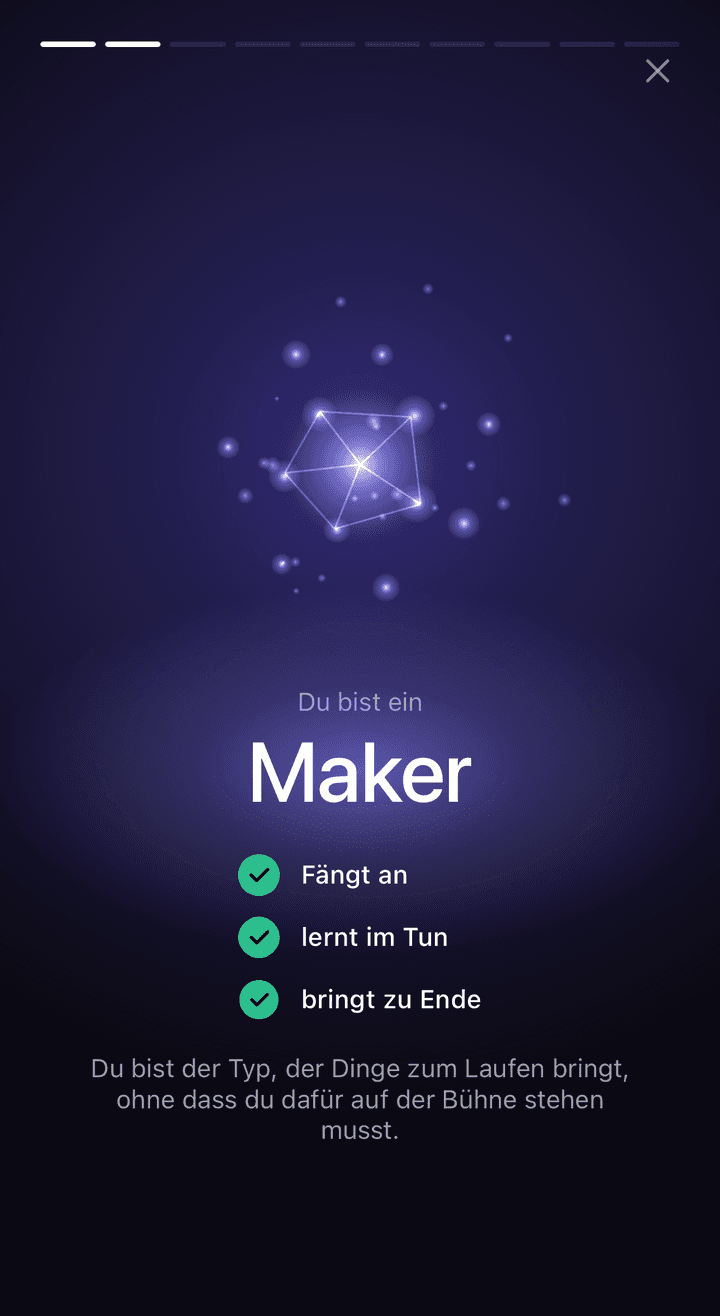
At the end of the conversation there is no bar chart. The reveal runs as a sequence: first your type, then three chapters, then potential and rank, then your first step.
- Intro
- Your type
- Three chapters
- Potential & rank
- Trajectory
- Your first step
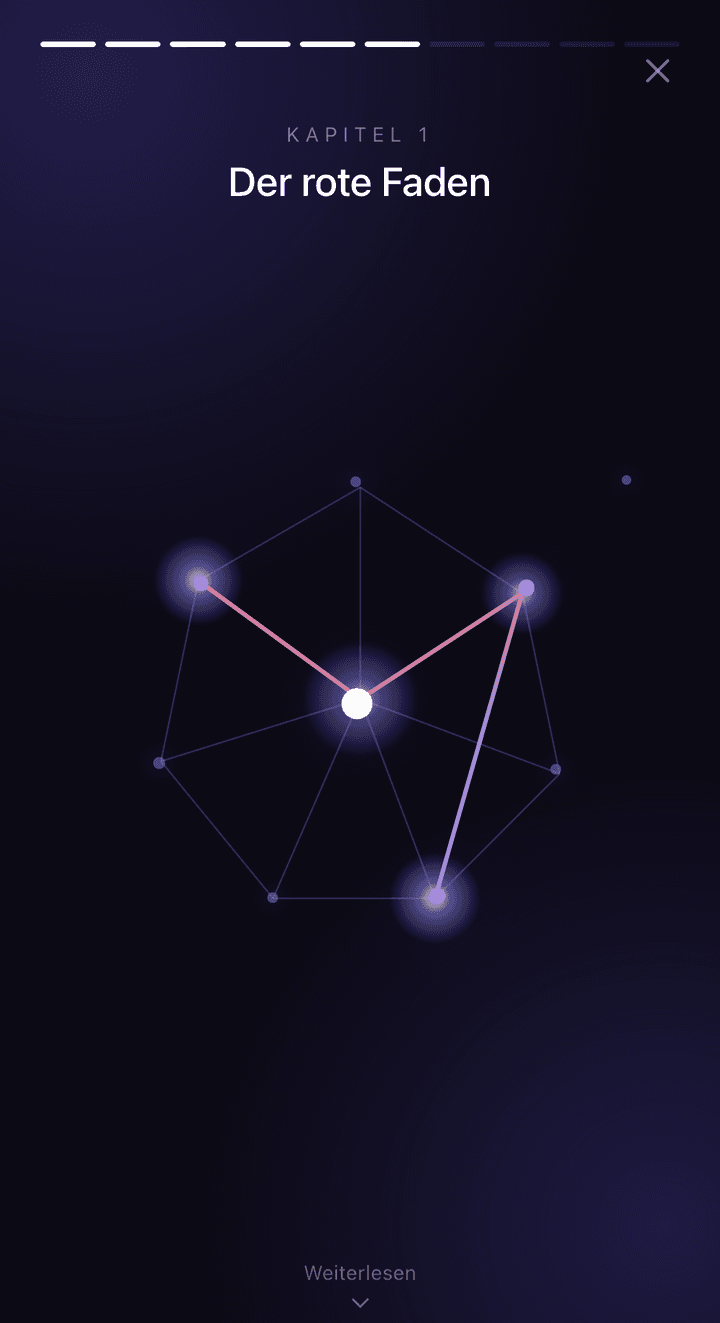
Chapter 1
The red thread
The pattern running through all of your answers.
Chapter 2
The blind spot
The opening almost everyone of your type overlooks.
Chapter 3
The shadow
Where you are most likely to slow yourself down, plus a concrete antidote.
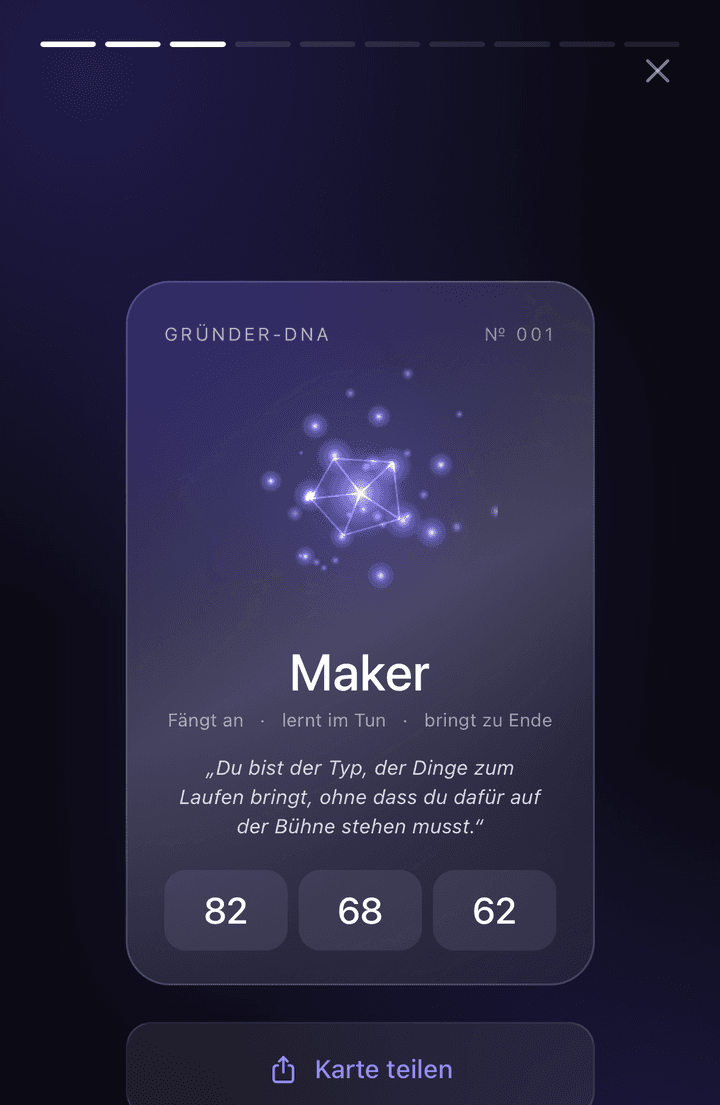
The third chapter does not stop at the diagnosis: the shadow comes with a concrete antidote. At the end there is a shareable card in portrait format. Whether you share it is up to you.
Archetypes
The four archetypes
The archetype is the short form of your profile: how you approach things, not what you can do. It sits next to the twelve axes, not in their place.
Visionary
Traits
- Thinks big
- Decides fast
- Sees the whole
Maker
Traits
- Starts
- Learns by doing
- Finishes
Connector
Traits
- Brings people together
- Gets things moving
- Thinks in directions
Architect
Traits
- Builds systems
- Thinks in structures
- Plans ahead
For missions, journex puts squads together so the archetypes complement each other. Up to four people per squad.
Rank & potential
Seven levels, and yours is private
Next to the archetype, the profile shows your potential and your trajectory: where it goes if you keep at it. The rank is the level you are standing on right now. Where you enter comes out of your profile.
- Bronze
- Silver
- Gold
- Platinum
- Diamond
- Elite
- Visionary
The rank moves with XP, which you earn for completed Journey steps and for missions. Rank names are the same in both languages.
You get a starting rank that moves with every step. Your rank is private. It never shows up in any social space.
Skill axes
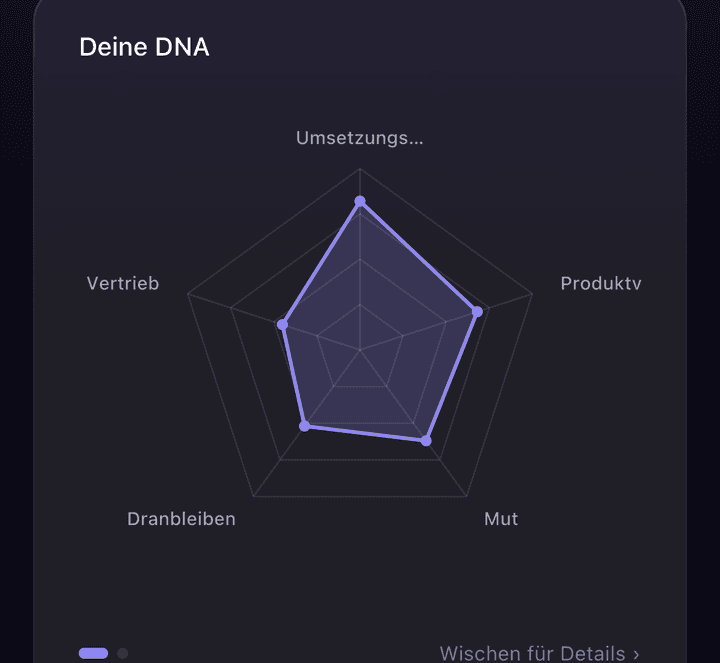
Twelve axes instead of one grade
Your strengths spread across twelve axes. This is the detailed part of the profile. It shows where you stand today, split by area instead of collapsed into a single number.
- Execution
- Market sense
- Vision & strategy
- Product
- Visibility & marketing
- Story & pitch
- Money & numbers
- Team & leadership
- Network & sales
- Growth
- Courage & decisions
- Sticking with it
Method
How we know this
- Your profile comes from your own answers, not from assumptions about you.
- We look for patterns, not single sentences. No guessing, no box.
- You can view, change or delete all of it at any time.
What the AI does and what it does not
The analysis is done by an AI model (Claude by Anthropic). It leads the conversation, builds the profile from it, later writes the guides for your project and reads your proof.
It does not make decisions about people. Nobody is judged or sorted out by it, and your profile is not a verdict on you.
Insight Vault
Five kinds of Insight
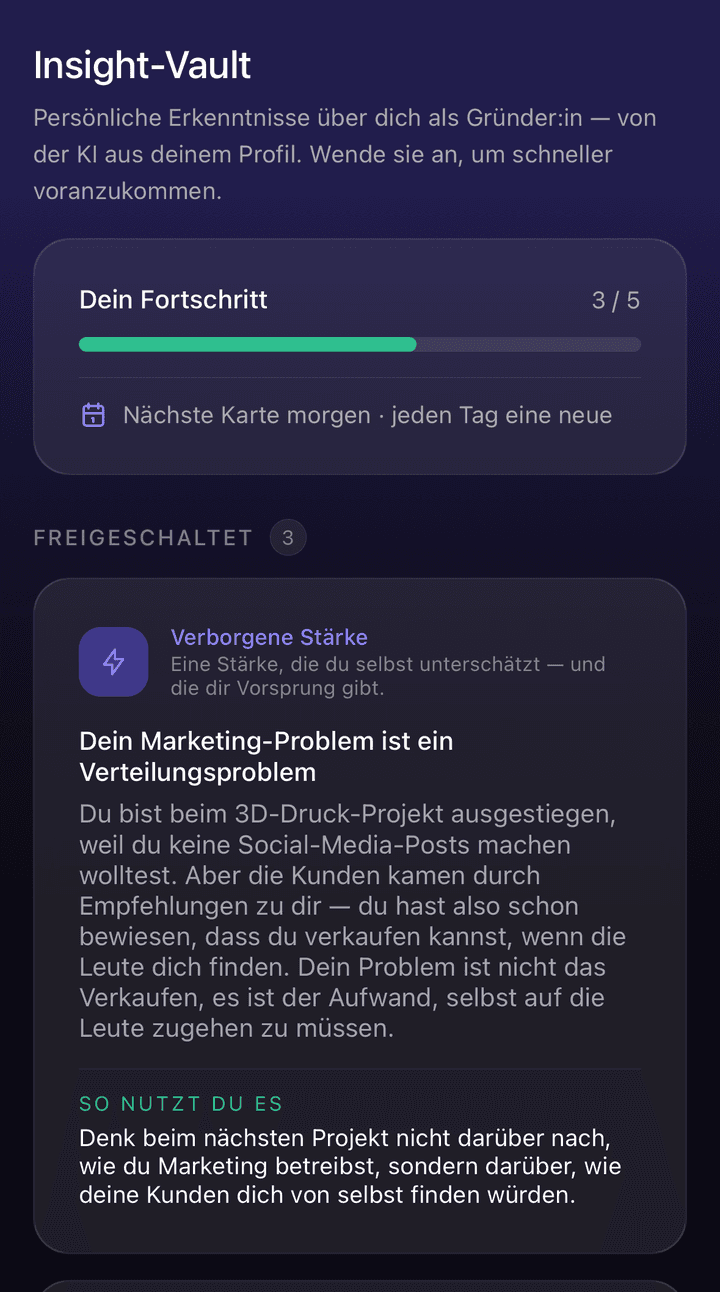
The conversation produces Insights: short cards that sit in your Insight Vault and stay there. Every card also says how to put it to use.
Hidden strength
A strength you underrate in yourself, and one that gives you a head start.
On every card: "How to use it"
Aha moment
A realisation about yourself that suddenly explains a lot.
On every card: "How to use it"
Missed opportunity
An opening most people miss. For you it is right there.
On every card: "How to use it"
Your stumbling block
What is most likely to throw you off. Spotted early, easy to avoid.
On every card: "How to use it"
Small experiment
A tiny test that gets you real feedback.
On every card: "How to use it"
The first step is a conversation
After that your profile is there, and it turns into your first project: ten steps into the real world, each one with proof.